

Café · Ottawa · ⭐ 9.1/10 · 1118 reviews · updated: 2026-08-10 17:35:50
Address: 130 Anderson St, Preston St, Ottawa, ON K1R 7P6, Canada
Ottawa has a coffee chain that began in a church basement, and this is the building where it roasts. Bridgehead Roastery and Coffeehouse in Little Italy is the flagship of a company that started in 1981 as an attempt to get a fair deal for smallholder farmers in Nicaragua, survived being owned by a charity, nearly died in the 1990s and was rebuilt into one of the most recognizable independent-minded coffee brands in the capital. Every cup poured across the chain is roasted here — which makes this the one address where the whole story is visible in a single room.
Highlights
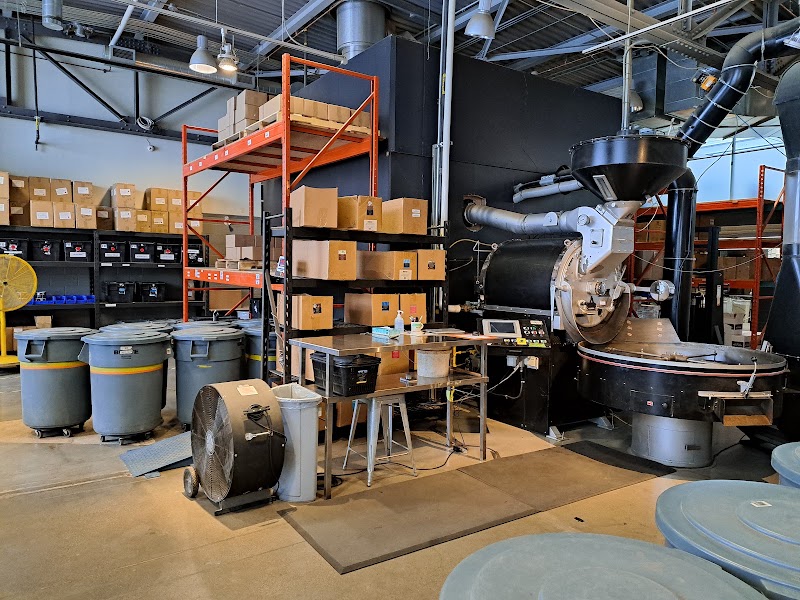
- The roastery for the whole chain. This is not a branch that receives coffee; it is where all of the company’s coffee is roasted and then distributed to its cafés across the city.
- A fair-trade origin story that predates the label. The business was founded in 1981 by two United Church ministers and two activists concerned about small coffee growers, and sold Canada’s first fairly traded coffee out of church basements.
- Rescued rather than launched. After a charity-owned decade ended in failure, Tracey Clark bought the brand at the end of the 1990s and reopened it as a coffeehouse company, starting with a single room in Westboro.
- Food from the company’s own kitchen. A central kitchen was opened early in the chain’s life to make its own food line, so what is in the cabinet belongs to the same business as the coffee.
- Coffee studied under a microscope. The company has worked with a Carleton University research centre on how coffee beans age — an unusually literal version of the phrase “we take freshness seriously”.
- A flagship, not a neighbourhood café. The scale and function of this building make it a different experience from the small Bridgehead rooms scattered across Ottawa, which is exactly why it is worth choosing deliberately.
What’s in the cup
Bridgehead roasts everything it sells, and it does so here. That single fact separates the company from most chains of comparable size in Canada, where roasting is outsourced and the brand is a retail operation with a logo on the cup. Here the supply chain runs from farmer co-operatives, through a roasting floor in Little Italy, to around twenty cafés in one city — short enough that the people selling the coffee can tell you what happened to it.
The sourcing principle is the company’s founding idea rather than a later marketing addition. Bridgehead exists because a small group of people in the early 1980s wanted Canadians to be able to buy coffee that paid its growers properly, and fair trade has stayed at the centre of the identity through every change of owner since. In practice, that shows up as long relationships with producer co-operatives rather than as one-off lots bought at auction, and it shapes the house style: a chain that buys the same coffees year after year builds a profile around consistency and body rather than around the chase for a novel single origin.
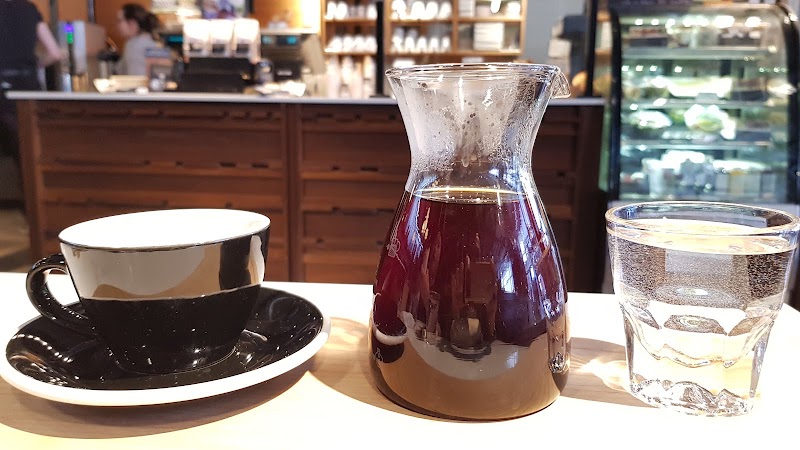
That is the honest calibration to make before visiting. If you want a bar where the filter changes twice a week and someone talks you through a competition lot, Ottawa has smaller rooms that do that better. What Bridgehead offers instead is a reliably good, ethically traceable cup produced at genuine scale — and at the roastery specifically, the shortest possible distance between the machine that roasted it and the cup in your hand. There is also more to the drinks list than coffee; tea has been part of the identity since the fair-trade importing days, which is not true of most coffee chains.
Who’s behind it
The founding cast in 1981 was two United Church ministers and two social activists, and the first sales were made by volunteers out of church basements. Oxfam Canada took the business over in the mid-1980s and turned it into a for-profit company; the attempt to broaden it into a general fair-trade retailer went badly, and by the mid-1990s the venture had effectively failed.
What happened next is the part that matters for the café you are standing in. At the end of the 1990s Tracey Clark bought the brand with the intention of returning it to what it had been good at — fairly traded coffee and tea — and opened the first Bridgehead coffeehouse in Westboro in 2000, financing the early years through family, friends and eventually a few dozen small investors. From that single room the company grew into a chain, added its own kitchen, and eventually built the roasting operation that this building houses.
Ownership has changed twice since. In 2019 the chain was bought by the parent company of Second Cup, and a few years later it passed to Pilot Coffee Roasters of Toronto. For a brand whose whole reputation rests on independence and ethics, that is not a trivial detail, and it is one of the things regulars argue about. What has not changed is the roasting address, the fair-trade sourcing story, or the fact that this is where the chain’s coffee comes from.
Which kind of visit it suits
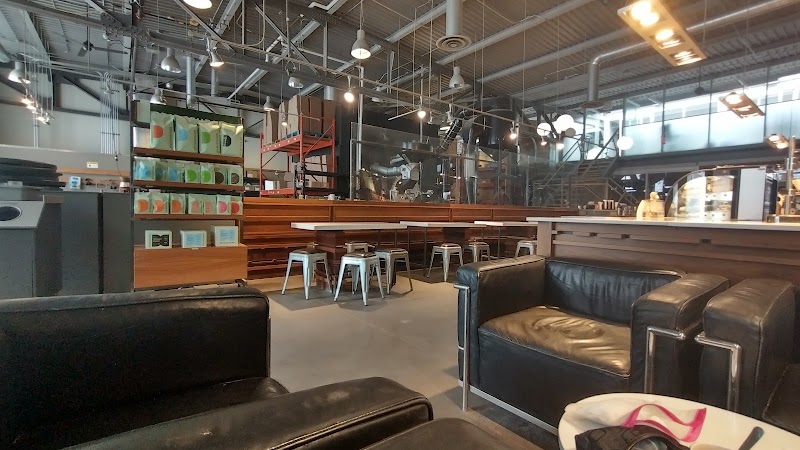
Of everything on this list, the roastery is the address that best supports the long stay. It is a large, purpose-built room rather than a cramped storefront, which means there is space to sit down with a laptop, a book or another person without immediately becoming an obstacle. Bridgehead cafés have functioned as the city’s unofficial working rooms for two decades — students, freelancers, public servants between meetings — and the flagship absorbs that traffic better than the small neighbourhood branches do. The company does not publish a working policy, power provision or time limit, so treat all of that as unspoken convention rather than a promise, and be realistic at the busiest moments.
It works equally well as a meeting place, and for a specific reason: it is easy to describe and easy to find, it is not so quiet that a conversation feels overheard, and there is enough room that two people can talk for an hour without a queue forming behind them. For a first meeting with someone you do not know, the neutrality is an advantage.
The takeaway visit is served all day and is the reason a large share of the traffic exists. And there is a fourth reason to come that the small branches cannot offer: buying the coffee itself, at the place it was roasted, with the roasting floor a few steps away. If you brew at home, that is the difference between shopping and visiting.
The room and the mood
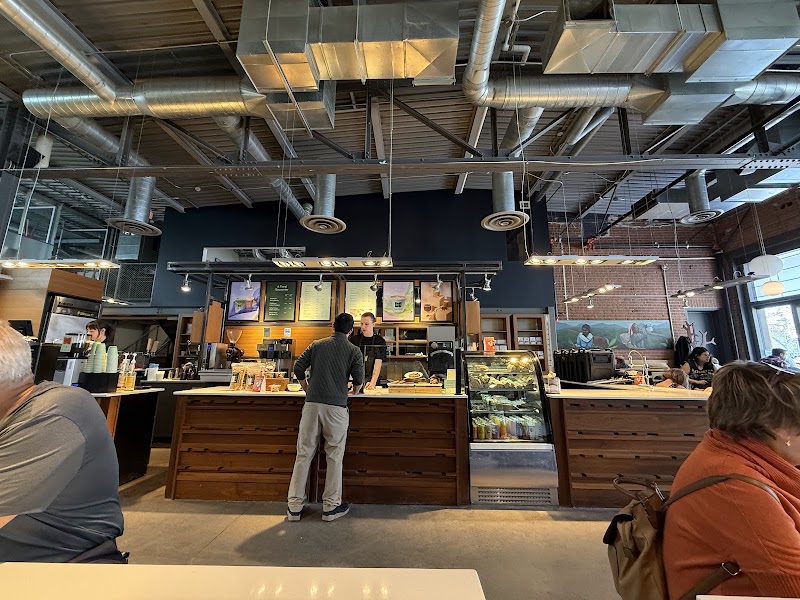
The building is a working roastery with a coffeehouse in it, and that dual purpose defines the atmosphere. It is bigger and more industrial in feel than the domestic-scaled Bridgehead rooms elsewhere in the city, with the production side present rather than hidden — the point of a flagship roastery is that you can see what is normally kept behind a warehouse door.
Because of the scale, the noise level is that of a busy public room rather than of a hushed café: conversation, machinery, the door. That makes it forgiving — you will not feel that the whole room can hear you — but it is not the venue for a quiet, intimate hour. Anyone looking for velvet and candlelight is in the wrong part of Little Italy.
The location adds its own character. This is the light-industrial edge of a neighbourhood better known for its restaurant strip, a pocket that has been steadily redeveloped, and the café sits in that transitional texture of old workshops and new buildings. It suits the business: a company that roasts for twenty cafés belongs in a working building, not in a boutique.
Beyond the coffee
The food question has an unusual answer here. Bridgehead built a central kitchen for its own food line early in its life, so the sandwiches, baked goods and breakfast items in the cabinet are the company’s own production rather than a wholesaler’s delivery — but they are made for the chain rather than cooked to order in front of you. That is the honest binary: house-made, but at chain scale, and not a restaurant kitchen.
In practice this makes the café a genuinely usable stop for a working breakfast or a quick lunch, which is more than most roastery cafés manage. It also means the offer is standardized: what you find here is broadly what you would find at the company’s other rooms, with the flagship’s advantage being freshness of coffee rather than a different menu. Some locations in the chain have also been licensed to serve beer, wine and coffee-based cocktails; whether that applies on any given visit is worth checking rather than assuming.
When to come
The roastery follows the working rhythm of a city of civil servants: an early and heavy start as people collect coffee on the way in, a busy midday, and a long quieter afternoon that is by far the best time to sit. If you are here to work or to talk, aim for the stretch after the lunch traffic has thinned. If you are here to buy beans and ask questions, the same advice applies for the opposite reason — people behind the counter have time.
Seasonally, this is a year-round room rather than a summer destination; the appeal is indoors and functional. Little Italy’s calendar does affect it, though: the neighbourhood’s summer festival weeks fill the whole district, and the streets around fill up accordingly.
Getting there
The roastery sits in Little Italy, on the light-industrial side of the district rather than on the restaurant strip, a short walk from Dow’s Lake and from the Trillium Line, which makes it straightforward to reach from downtown or from the south of the city without a car. Bus service through the neighbourhood is frequent, and the canal cycling network is close enough that arriving by bike is realistic for much of the year.
For drivers, this part of Little Italy is easier than the restaurant strip a block away, but it is still a dense urban grid with limited and partly restricted kerbside space. As everywhere in this neighbourhood, the practical approach is to park once and walk — and the walk to Dow’s Lake and the canal from here is a pleasant one.
Good to know
The most useful thing to know is that one name covers two quite different experiences. The neighbourhood Bridgehead cafés are small local rooms; this is the flagship where the coffee is made. If someone tells you Bridgehead is unremarkable, ask which one they went to — the difference between a small branch and the roastery is real.
Second, the ethics: the fair-trade commitment is the company’s founding purpose rather than a modern marketing layer, and it survived four decades and several changes of ownership. If that matters to you as a consumer, this is one of the few coffee brands in the country that can point to a genuine paper trail, and this address is where the story is most tangible.
The honest weaknesses are the ones of scale. A chain roasts for consistency, so the coffee will not surprise you the way a micro-roastery’s rotating lot can. The room is functional rather than beautiful. And the ownership question — a fair-trade pioneer now sitting inside a larger corporate structure — is a legitimate thing to weigh if independence is part of what you are buying. What remains beyond argument is that the coffee in your cup was roasted in the same building, which is a claim very few cafés in Ottawa can make.
Questions and answers
Is this where Bridgehead’s coffee is roasted?
Yes. All of the company’s coffee is roasted here and distributed from here to its cafés around the city, which is what distinguishes this address from the neighbourhood branches.
How old is the company?
It goes back to 1981, when two United Church ministers and two activists began selling fairly traded coffee to support small growers in Nicaragua — initially out of church basements.
Who owns it now?
It was bought in 2019 by the parent company of Second Cup, and later passed to Pilot Coffee Roasters of Toronto. Before that it was rebuilt and run by Tracey Clark, who bought the brand at the end of the 1990s.
Is the coffee actually fair trade?
Fair trade is the reason the business exists, and it has stayed central through every change of ownership. The model is built on long relationships with producer co-operatives rather than on one-off purchases.
Is it a good place to work or study?
It is one of the better options in the city thanks to its size and layout, and Bridgehead rooms have served that role in Ottawa for two decades. Nothing is officially promised about power or duration, so treat it as convention rather than policy.
Is the food made in-house?
It comes from the company’s own central kitchen rather than from an outside supplier, but it is produced for the chain rather than cooked to order here. Useful for breakfast or a light lunch; not a restaurant.
Can I buy beans here?
Yes, and this is the most logical place in the city to do it, since the roasting happens on site.
How is it different from the other Bridgehead cafés?
Scale and function. The others are small neighbourhood rooms; this is a purpose-built roastery with a coffeehouse attached, and the production side is part of what you see.
Is there alcohol?
Some locations in the chain have been licensed for beer, wine and coffee-based cocktails. It is worth checking rather than assuming it applies here.
What is the surrounding area like?
Little Italy, but its working edge rather than the restaurant strip: a redeveloping pocket of old and new buildings, a short walk from Dow’s Lake and the canal.
Opening hours
| Day | Hours |
|---|---|
| Monday | 06:00–18:30 |
| Tuesday | 06:00–18:30 |
| Wednesday | 06:00–18:30 |
| Thursday | 06:00–18:30 |
| Friday | 06:00–18:30 |
| Saturday | 06:30–18:30 |
| Sunday | 06:30–18:00 |
Photos
Visitor reviews
Reviews last updated: 2026-08-10 17:35:50
Data is refreshed monthly. Sources: ottawanka.com and editorial picks based on reviews.
I absolutely love this coffee shop! The staff are incredibly friendly, making every visit a delightful experience. Alex, in particular, has become a personal favorite of mine; he remembers little details about you and ge…
Атмосфера чудова, персонал привітний, а кава чудова. Однак, у бублика з лососем є невеликий недолік: він мені видався досить прісним. Помідори погано поєднуються з лососем, і я думаю, що їх краще замінити руколою або аво…
Обожнюю це чудове місце.
Сьогодні було так спекотно, що я заскочив сюди. Дуже тихе, чудове місце!
Дуже смачна кава, приємна атмосфера, поруч із озером Даунс, варіанти транспорту поїздом O-Train в обох напрямках. Завіта…
Я сьогодні вперше був тут. Через проливний дощ я вирішив зайти та спробувати цю кав'ярню. Приємна та простора атмосфера. Баристер приготував чудовий лате. Я попросив зробити його менш солодким. Однак круасан не такий вже…
Кава ароматна, смачна та автентична.
Однак, вони приділяють забагато місця виробництву, тому зона для сидіння досить обмежена.