

Café · Ottawa · ⭐ 9.3/10 · 1243 reviews · updated: 2026-08-10 17:35:49
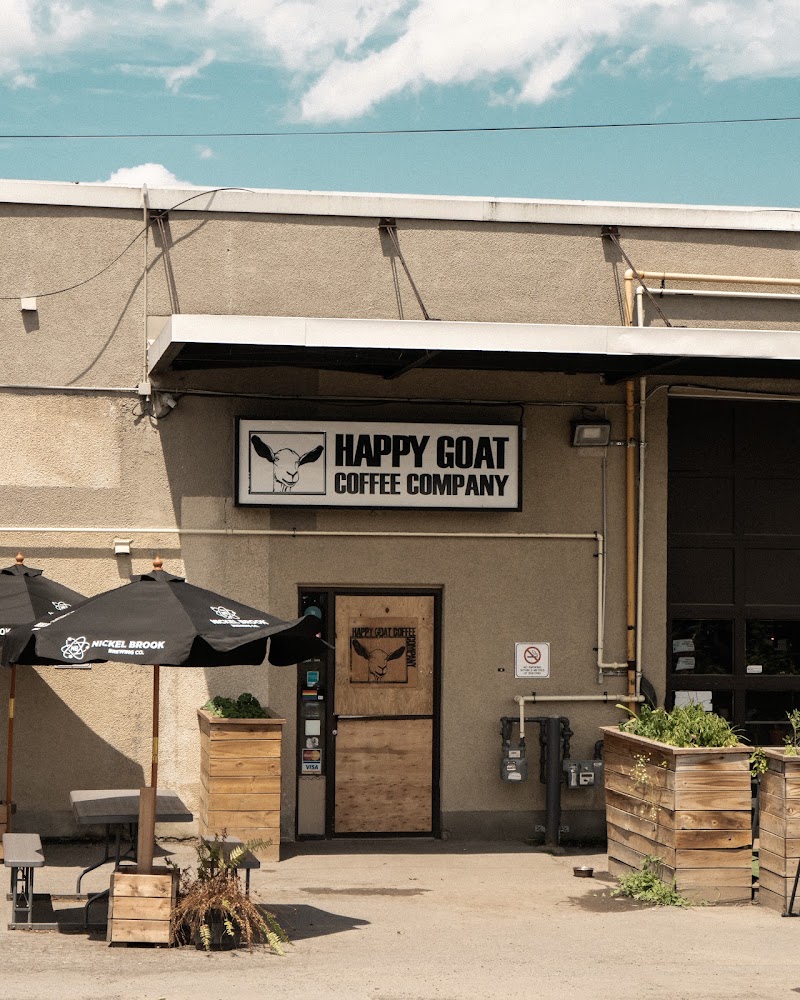
Address: 35 Laurel St, Ottawa, ON K1Y 4M4, Canada
Order a coffee almost anywhere independent in Ottawa and there is a fair chance the beans came from here. Happy Goat Coffee Co. in Hintonburg is the original address of a roastery that now supplies dozens of cafés, restaurants and offices across the city, and it is still the room where the roasting happens rather than a branch that receives sacks from somewhere else. That distinction is the whole reason to choose this location over the fifteen or so others carrying the same name: this is the source, and it behaves like one.
Highlights
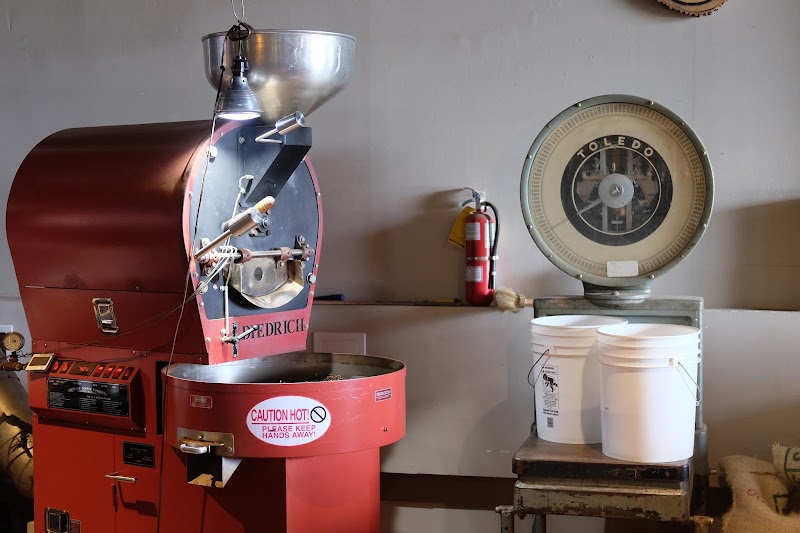
- The original, and the roastery. The company grew out of a garage operation in 2010 and this is where it settled; beans are roasted on the premises in small batches rather than trucked in finished.
- Drip that changes with the roast. Because production and counter share a building, the filter coffee rotates according to what has just come off the roaster instead of sitting on a fixed house blend all year.
- A master roaster with an unusual CV. The roasting is led by Dr. Hans Langenbahn, whose background is anthropological as much as technical and who travels regularly to Addis Ababa to work with partnered growers.
- Direct relationships, not a broker list. The company buys from growers across seven or more coffee regions through relationships it maintains itself, which is rare at this volume.
- The name is a coffee origin myth. It comes from the legend of the dancing goats — the Ethiopian tale of a herder noticing his animals behaving strangely after eating certain berries.
- Beans to take home. This is the one address where the retail shelf, the roaster and the espresso machine are all in the same room, which makes it the logical place to buy rather than just to drink.
What’s in the cup
Unlike most cafés on any city’s list, Happy Goat is a roaster first and a café second, and the cup reflects that order of priorities. The beans are bought through direct relationships with growers across several coffee-producing regions, roasted in Ottawa in small batches on professional equipment, and then sold across the city — which means what you drink here is not a product bought in but the house’s own output, tasted at the shortest possible distance from the roaster.
The practical effect shows up in the filter offer. In a café that buys its coffee, the drip is a fixed decision made months in advance; here it moves with production, so the coffee waiting in the batch brewer is often whatever was roasted most recently. Ask what is on and you will get a real answer rather than a shrug, and if you are the kind of drinker who wants to taste the difference between one origin and the next, this is a room where that question is welcome. Espresso and milk drinks are prepared to the standard you would expect from a company whose beans are being judged in dozens of other cafés at the same moment — consistency matters more to a roaster than to anyone else, because every cup is an advertisement.
The sourcing story is worth taking seriously because it is documented rather than decorative. The master roaster’s connection to Ethiopia is not a marketing line about “our partners at origin” — he has worked in the region and returns to it, and the company’s East African coffees carry that relationship. That does not automatically make every cup extraordinary, and a roastery this size inevitably has a house style that suits volume. But the chain of custody from grower to your table is short, real and checkable, which is more than most cafés can honestly claim.
Who’s behind it
The business started in 2010 with Pierre Richard, who was interested in traditional roasting and brewing methods and began, as these stories usually go, in a garage. Today the company is run by owner Henry Assad, and its coffee identity is shaped by master roaster Dr. Hans Langenbahn, whose scientific and anthropological understanding of coffee from seed to cup gave the company its sourcing philosophy as well as its roasting profile.
That three-part history explains the odd position Happy Goat occupies in Ottawa. It is unambiguously a local business with a founder’s story, and simultaneously a company large enough to run cafés in the National Gallery, in a landmark hotel, in transit kiosks and in the Greater Toronto Area. Some visitors read the growth as a loss of independence; others read it as the most successful expansion any Ottawa coffee company has managed. Both readings are defensible, and the roastery is the place where the argument is easiest to settle, because here you can see the actual production rather than only the branding.
Which kind of visit it suits
The strongest reason to come here specifically is the errand: buying beans where they were roasted, asking what is fresh, and getting an answer from people who work beside the machine. If you brew at home, this is a genuinely different shopping experience from picking up a bag in a supermarket, and it is the visit this location serves better than any other in the group.
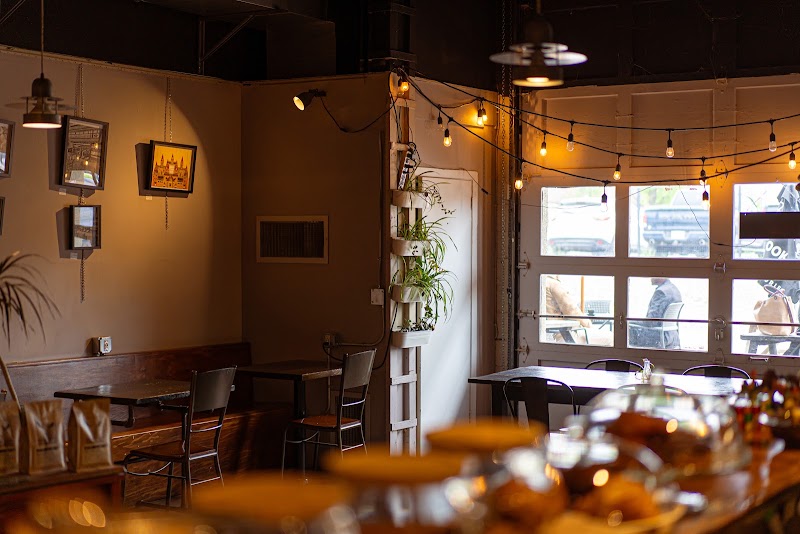
For sitting, the room works best for the unhurried middle of the day — a conversation, a book, a coffee that you actually taste rather than inhale on the way somewhere. The neighbourhood setting helps: this is not a downtown transit café where everyone is passing through, and the pace at the tables is correspondingly slower. As for laptops, the honest answer is that the café publishes no policy on working, power or time limits, so treat a working session as a reasonable bet rather than a guarantee, and read the room at busy moments. A roastery café with a retail counter has a different traffic pattern from a dedicated study café, and the seat you are occupying may be needed.
The takeaway scenario is served too, and heavily — a large share of the custom here is people collecting a cup on their way through Hintonburg. If that is you, it is worth noting that the same brand runs kiosks and counters all over the city, several of them built precisely for the grab-and-go moment. Coming to the roastery to take a cup away and leave is fine, but it is the one visit that could be made anywhere.
The room and the mood
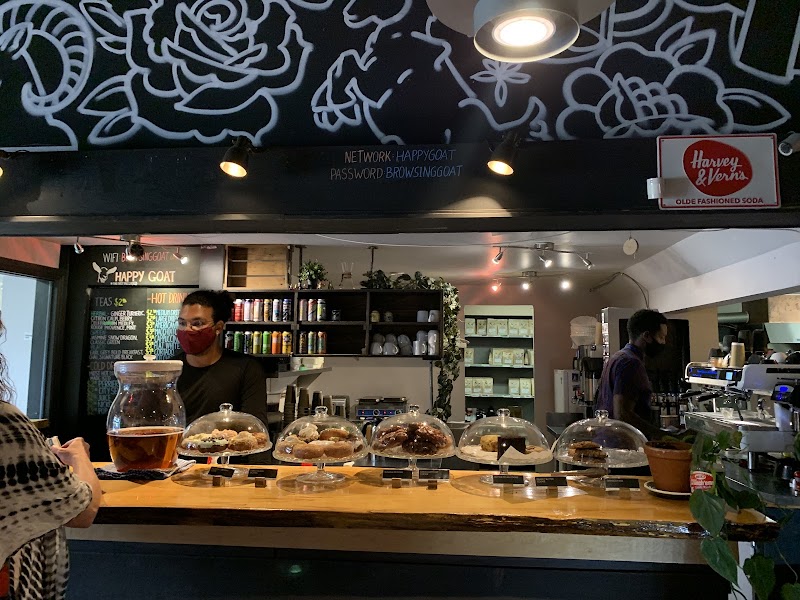
The space has a relaxed, faintly bohemian character that suits its corner of the city — an area of low buildings and small industry that has been slowly turning residential and creative for two decades. It is not a designed, photogenic interior in the way that newer Ottawa cafés are; it reads as a working building where a café happens, which is exactly what it is.
The presence of production on site is the atmospheric detail that matters. Roasting has a smell that no amount of interior design can imitate, and on a day when the machine is running, the room is a reminder of what a coffee shop actually is. The soundtrack is correspondingly practical rather than curated: staff moving stock, the grinder, conversation. It is a comfortable room to be alone in and an easy one to talk in, without ever being precious about either.
Anyone travelling specifically for the interior should calibrate expectations. This is not the ornate, dressed-up kind of café; the appeal is authenticity of function rather than atmosphere as theatre. If what you want is a beautiful room, Ottawa has those. If what you want is to drink coffee where it is made, that is here.
Beyond the coffee
The food side is handled in-house rather than bought in: the company runs its own bakery supplying its cafés, and the counter carries baked goods, doughnuts and sandwiches made within the business rather than delivered by a wholesaler. That is the binary that matters — this is a café where the pastry belongs to the same operation as the coffee, which is not the norm among coffee bars of this size.
What it is not is a brunch restaurant. There is no kitchen turning out plates to order, and a visit built around a substantial sit-down meal will be a disappointment. Think of the food as properly made accompaniment rather than as a destination in its own right, and plan a full lunch elsewhere in the neighbourhood, which has no shortage of options.
The retail side deserves a mention alongside the food, because it is unusually complete here: whole beans across the range, brewing equipment, and a subscription service for people who would rather have the coffee arrive than come and get it.
When to come
The rhythm of the place is set by two things: the commuter flow through Hintonburg and the roasting schedule. The first fills the counter early, when a good share of the traffic is people collecting something to carry away; the second means the interesting filter coffee turns over during the week. If your visit is about tasting rather than caffeinating, come when the counter is calm — the middle of the afternoon is reliably the easiest moment to have a real conversation about what is in the hopper.
Seasonally, this corner of the city is at its best in warm weather, when the river pathways and the neighbourhood’s strip are full and a coffee here fits naturally into a longer walk. In winter it becomes what it fundamentally is: a neighbourhood room with a roaster in it, quieter, less transient, and arguably better for it.
Getting there
The café sits on the Hintonburg and Mechanicsville boundary, in the low-rise pocket north of the neighbourhood’s shopping strip and close to the Ottawa River pathway. It is an easy walk from the Confederation Line, and the bus network through this part of the city is dense, so arriving without a car is straightforward. Cyclists have it best of all: the riverside path system runs within a few minutes and connects the whole western side of the city to the door.
Drivers should expect the constraints of an old, tight residential grid — limited kerbside space, permit restrictions in places, and neighbours who use it. The area rewards leaving the car once and walking, since the surrounding blocks have become one of the better independent food and shopping districts in Ottawa.
Good to know
The most useful thing to understand before you go is that one name here covers several very different formats. Happy Goat runs full cafés, transit kiosks, counters inside institutions and retail partnerships, and the experience varies enormously between them. A kiosk in a station is not this. If someone recommends the brand to you and you want the real thing, the roastery is the address to look for.
Second: because the company supplies dozens of other businesses around the city, you will meet these beans elsewhere — in independent cafés, in restaurants, on shop shelves. That is a compliment to the roastery rather than a reason to skip it, but it does mean the coffee itself is not exclusive to the room.
The honest caveats are those of a working roastery café rather than a hospitality showpiece. Comfort is functional rather than luxurious, the space is shared with a business that has other things to do, and specifics such as seating, outlets and long-stay policy are simply not published — plan for a good coffee and a pleasant hour, and treat anything beyond that as a bonus. Set against that, very few cafés in the country let you buy a bag of coffee from the same room where it was roasted, and that is a real thing to travel across a city for.
Questions and answers
Is the coffee roasted here?
Yes. This is the company’s original address and beans are roasted on the premises in small batches, which is precisely what separates it from the brand’s other locations.
What makes this branch different from the other Happy Goat cafés?
The others receive the coffee; this one makes it. It also has the fullest retail selection and the most knowledgeable answers about what is currently fresh.
Where do the beans come from?
From growers in several coffee regions, bought through relationships the company maintains directly. Its East African sourcing in particular is tied to the master roaster’s long-standing work in the region.
Can I buy beans and equipment to take home?
Yes — whole beans across the range, brewing gear, and a subscription for people who prefer the coffee to arrive rather than to be fetched.
Is the filter coffee always the same?
No, and that is the point. It rotates with what has recently been roasted, so it is worth asking rather than assuming.
Is there food?
Baked goods, doughnuts and sandwiches, made by the company’s own bakery rather than bought in. It is not a brunch kitchen and does not pretend to be.
Is it a good place to work?
Possibly, but nothing is promised. No working policy, power provision or time limit is published, so treat a session as a reasonable bet at a quiet hour rather than something to plan a whole day around.
Who founded it?
Pierre Richard started the business in 2010 out of a garage; it is now owned by Henry Assad, with Dr. Hans Langenbahn as master roaster.
Why the goat?
From the legend of the dancing goats — the origin myth in which a herder notices his animals behaving oddly after eating the berries of an unfamiliar shrub.
What is the neighbourhood like?
Hintonburg and Mechanicsville: low-rise, formerly industrial, now one of Ottawa’s better independent shopping and eating districts, with the river pathway a few minutes away.
Opening hours
| Day | Hours |
|---|---|
| Monday | 07:30–18:00 |
| Tuesday | 07:30–18:00 |
| Wednesday | 07:30–18:00 |
| Thursday | 07:30–18:00 |
| Friday | 07:30–18:00 |
| Saturday | 07:30–18:00 |
| Sunday | 07:30–18:00 |
Photos
Visitor reviews
Reviews last updated: 2026-08-10 17:35:49
Data is refreshed monthly. Sources: ottawanka.com and editorial picks based on reviews.
I’m not a regular customer since I don’t live in the area but I sometimes deliver kitchen items for them. I’m not sure if he’s the owner or part of the management but the care he shows to delivery drivers is beyond words…
Така мила, затишна кав'ярня. Чай лате з вівсяним молоком дуже смачний, як і їжа. Багато місць для сидіння та розваг.
Дивне місце з невибагливим екстер'єром, але надзвичайно милим інтер'єром та привітним персоналом. Відчуття було схоже на підпільний бар. Один з найкращих лате, які я коли-небудь куштував. Сендвіч на сніданок був смачним,…
Я купив кавові зерна в цьому місці, і мені дуже сподобалося! Я забув суміш, але рекомендую їхню каву, оскільки зазвичай купую в їхніх пунктах легкорейкового транспорту. Рекомендую будь-яку суміш кави, всю місцевого обсма…
Раніше тофу в лаваші був моєю найулюбленішою стравою, мені буквально хотілося його з'їсти вранці. Не знаю, коли і як це змінилося, але тепер це просто прісний тофу зі шпинатом? На дошці перераховано стільки інгредієнтів,…